lactf-1986#
Dug around the archives and found a floppy disk containing a long-forgotten LA CTF challenge. Perhaps you may be the first to solve it in decades.
Overview#
This was a really fun challenge that I solved during LACTF 2026. The binary was programmed in a 16-bit x86 DOS environment, which immediately made the analysis more interesting. One of the main difficulties came from the limited tools available for analyzing this binary and converting it into a readable C-like pseudocode, instead we have to work directly with the raw low-level assembly code.
The tools that I used to solve this challenge are DOSbox-x for debugging and radare2, IDA for disassembling
Reconnaissance#
The challenge gives us only CHALL.IMG which is a floppy disk image file type
1
2
| $ file CHALL.IMG
CHALL.IMG: DOS/MBR boot sector, code offset 0x3c+2, OEM-ID "IPRT 6.2", root entries 224, sectors 2880 (volumes <=32 MB), sectors/FAT 9, sectors/track 18, serial number 0x46ba57e0, label: " ", FAT (12 bit), followed by FAT
|
Using binwalk we can extract all the embedded files in this image. However, in this challenge, I recommend to use 7zip’s extraction tool, which is a really nice and fast way to retrieve the CHALL.EXE file
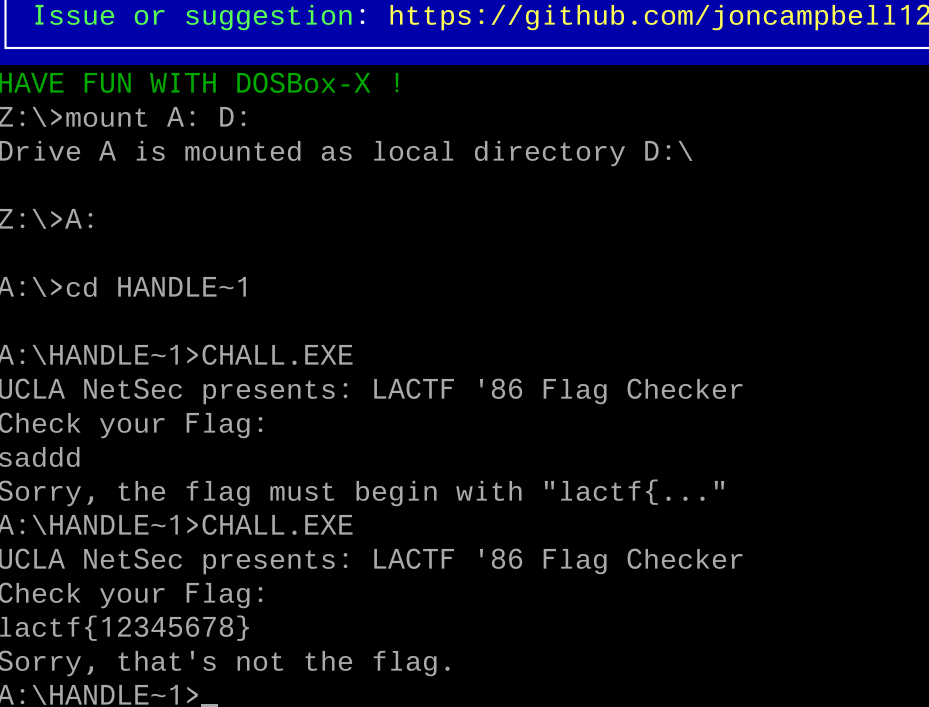
Using strings CHALL.exe to collect some useful clues, we can see these things
1
2
3
4
5
6
7
8
| UCLA NetSec presents: LACTF '86 Flag Checker
Check your Flag:
Sorry, the flag must begin with "lactf{..."
Sorry, that's not the flag.
Indeed, that's the flag!
Not enough memory to allocate file structures
Floating-point support not loaded
0123456789abcdefghijklmnopqrstuvwxyz
|
This is definitely a flag checker challenge
Analyze#
I would not dive deeply into my really tough analyzing process, I will directly point to the correct path of this challenge.
At first glance, I will use IDA to quickly analyze the challenge, however, the analyzed binary is just a bunch of raw assembly’s code. At this moment, I know I have to start dynamic debugging.
Opening DOSbox-x debugger and setting our classic analysis environment
The program flow should be
Read input -> check prefix -> do some changes with the input -> compare
In DOS, reading input should look like this
My next move is starting to dynamic debugging. First of all I will set breakpoint at int 21h using bpint 21 then turn on logging executing instruction in DOSbox-x using log 10000 then I spam f5 (this shortcut likely continues the program). Then analyze the LOGCPU.txt from DOSbox-x.
I search for the aforementioned reading input pattern. And I can easily figure out this program’s flow
Reading input -> fnc.0000027E (get length) ->
fcn.000000b0 (prefix's checker) -> fcn.00000010 (maybe encryption)
-> compare with ciphertext
fcn.00000010
1
2
3
4
5
6
7
8
9
10
11
12
13
14
15
16
17
18
19
20
21
22
23
24
25
26
27
28
29
30
31
32
33
34
35
36
37
38
39
40
41
42
43
44
45
46
47
48
49
50
51
52
53
54
55
56
57
58
59
60
61
62
63
64
65
66
67
68
69
70
71
72
73
74
75
76
77
78
79
80
81
82
83
84
85
86
87
88
89
90
91
92
93
94
95
96
| ┌ 107: fcn.00000010 (int16_t arg1);
│ `- args(ax) vars(3:sp[0xc..0x10])
│ 0000:0010 50 push ax ; arg1
│ 0000:0011 b81200 mov ax, 0x12
│ 0000:0014 e8b601 call fcn.000001cd
│ 0000:0017 58 pop ax
│ 0000:0018 53 push bx
│ ; DATA XREF from fcn.00001a14 @ 0x1a22(r)
│ 0000:0019 51 push cx
│ ; DATA XREF from fcn.00000776 @ 0x7be(r)
│ ; DATA XREFS from segment.seg_001 @ +0x2e6(r), +0x2e8(r)
│ 0000:001a 56 push si
│ 0000:001b 57 push di
│ ; DATA XREF from fcn.00001f7a @ 0x2038(r)
│ 0000:001c 55 push bp
│ 0000:001d 89e5 mov bp, sp
│ 0000:001f 83ec04 sub sp, 4
│ ; DATA XREFS from fcn.000000b0 @ 0xd6(r), 0xd9(w)
│ ; DATA XREF from fcn.00002150 @ 0x2171(r)
│ 0000:0022 50 push ax
│ ; DATA XREF from fcn.00000dec @ 0xdfd(r)
│ 0000:0023 c746fc0000 mov word [var_4h], 0
│ 0000:0028 31f6 xor si, si
│ ; CODE XREF from fcn.00000010 @ 0x6c(x)
│ ┌─> 0000:002a 8b5efa mov bx, word [var_6h]
│ ╎ ; XREFS: DATA 0x00000df9 DATA 0x00000f59 DATA 0x000011ed DATA 0x000019f7 DATA 0x00001b69 DATA 0x00001bd9
│ ╎ 0000:002d 8a07 mov al, byte [bx]
│ ╎ 0000:002f 8846fe mov byte [var_2h], al
│ ╎ 0000:0032 ff46fa inc word [var_6h]
│ ╎ 0000:0035 84c0 test al, al
│ ┌──< 0000:0037 7435 je 0x6e
│ │╎ ; DATA XREFS from fcn.00000ca4 @ 0xcc8(r), 0xd12(r)
│ │╎ 0000:0039 8b5efc mov bx, word [var_4h]
│ │╎ 0000:003c 89f7 mov di, si
│ │╎ ; DATA XREF from fcn.00002054 @ 0x205c(r)
│ │╎ ; DATA XREF from fcn.000022e9 @ +0x18(r)
│ │╎ 0000:003e b90600 mov cx, 6
│ │╎ ; CODE XREF from fcn.00000010 @ 0x45(x)
│ │╎ ; DATA XREF from fcn.00001a14 @ 0x1a29(x)
│ ┌───> 0000:0041 d1e3 shl bx, 1
│ ╎│╎ ; DATA XREF from fcn.00001078 @ 0x112d(r)
│ ╎│╎ 0000:0043 d1d7 rcl di, 1
│ ││╎ ; DATA XREF from fcn.00001078 @ 0x1129(r)
│ └───< 0000:0045 e2fa loop 0x41
│ │╎ ; DATA XREF from fcn.00001078 @ 0x147c(r)
│ │╎ 0000:0047 8b46fc mov ax, word [var_4h]
│ │╎ ; DATA XREF from fcn.000000b0 @ 0xed(r)
│ │╎ ; DATA XREF from entry0 @ 0x3c4(r)
│ │╎ ; DATA XREF from fcn.00002328 @ 0x2359(r)
│ │╎ 0000:004a 89f2 mov dx, si
│ │╎ ; DATA XREF from fcn.000004e1 @ 0x520(r)
│ │╎ ; DATA XREF from fcn.00000ca4 @ 0xd53(r)
│ │╎ 0000:004c d1e0 shl ax, 1
│ │╎ ; DATA XREF from fcn.00000ca4 @ 0xdc3(r)
│ │╎ 0000:004e d1d2 rcl dx, 1
│ │╎ ; DATA XREFS from fcn.000000b0 @ 0xe0(r), 0xe3(w)
│ │╎ ; DATA XREF from fcn.00001078 @ 0x1125(r)
│ │╎ ; DATA XREF from fcn.00002150 @ 0x2168(r)
│ │╎ 0000:0050 01d8 add ax, bx
│ │╎ 0000:0052 11d7 adc di, dx
│ │╎ 0000:0054 8b56fc mov dx, word [var_4h]
│ │╎ ; DATA XREF from fcn.00000ca4 @ 0xdbf(r)
│ │╎ 0000:0057 01c2 add dx, ax
│ │╎ 0000:0059 11f7 adc di, si
│ │╎ 0000:005b 8a46fe mov al, byte [var_2h]
│ │╎ 0000:005e 30e4 xor ah, ah
│ │╎ 0000:0060 31f6 xor si, si
│ │╎ ; DATA XREFS from fcn.00001078 @ 0x10a5(r), 0x146e(r)
│ │╎ 0000:0062 01c2 add dx, ax
│ │╎ ; DATA XREFS from fcn.00001078 @ 0x10dc(r), 0x1121(r)
│ │╎ 0000:0064 8956fc mov word [var_4h], dx
│ │╎ ; DATA XREF from fcn.00001078 @ 0x1417(r)
│ │╎ 0000:0067 11fe adc si, di
│ │╎ ; DATA XREFS from fcn.00001078 @ 0x1179(r), 0x1413(r)
│ │╎ 0000:0069 83e60f and si, 0xf
│ ││ ; DATA XREF from fcn.00000ca4 @ 0xd88(r)
│ │└─< 0000:006c ebbc jmp 0x2a
│ │ ; CODE XREF from fcn.00000010 @ 0x37(x)
│ │ ; DATA XREF from entry0 @ 0x448(x)
│ │ ; DATA XREF from fcn.00000a85 @ 0xaee(x)
│ └──> 0000:006e 8b46fc mov ax, word [var_4h]
│ 0000:0071 89f2 mov dx, si
│ ; DATA XREF from fcn.00000a85 @ 0xbe6(r)
│ ; DATA XREF from fcn.00001078 @ 0x1315(r)
│ 0000:0073 89ec mov sp, bp
│ ; DATA XREFS from fcn.00001078 @ 0x10d0(r), 0x1409(r)
│ 0000:0075 5d pop bp
│ ; CODE XREF from fcn.0000007b @ 0xae(x)
│ 0000:0076 5f pop di
│ ; DATA XREF from fcn.00000ca4 @ 0xda2(r)
│ 0000:0077 5e pop si
│ ; DATA XREFS from fcn.00001078 @ 0x10d4(r), 0x13b8(r)
│ 0000:0078 59 pop cx
│ 0000:0079 5b pop bx
│ ; DATA XREF from fcn.00000ca4 @ 0xd9e(r)
└ 0000:007a c3 ret
|
After analyzing this, this is just a simple hash the input using multi-precision technique, the 32-bit integer result is stored in dx:ax
1
2
3
4
5
| def hash(input: str) -> int:
h = 0
for c in input:
h = (67 * h + ord(c)) & 0xFFFFF
return h
|
Then the program starts its comparision with the hardcoded ciphertext hidden in the binary. Our input will be hashed by the above algorithms, then the program will loop 0x49 times. In each loop, it calls fcn.0000007b to make some encoding or math with the hash value, then it uses the low byte of computed value to compare with the ciphertext if all is matched, the flag is correct
Extracted ciphertext
1
2
3
4
5
6
7
8
| 0A5C:0BBA B6 8C 95 8F 9B 85 4C 5E EC B6 B8 C0 97 93 0B 58
0A5C:0BCA 77 50 B0 2C 7E 28 7A F1 B6 04 EF BE 5C 44 78 E8
0A5C:0BDA 99 81 04 8F 03 40 A7 3F FA B7 08 01 63 52 E3 AD
0A5C:0BEA D1 85 9F 94 21 D5 2A 5C 20 D4 31 12 CE AA 16 C7
0A5C:0BFA AD DF 29 5D 72 FC 24 90 2C 0A 5B 0C 00 00 70 0C
0A5C:0C0A 60 0C 20 0C DC 0C 60 0C FF FF 1E 21 B0 0C 00 00
0A5C:0C1A 5C 0A B2 0C 5C 0A 2E 0C 0C 00 60 0C FF FF 5B 17
0A5C:0C2A 0E 00 01
|
fcn.0000007b
1
2
3
4
5
6
7
8
9
10
11
12
13
14
15
16
17
18
19
20
21
22
23
24
25
26
27
28
29
30
31
32
33
34
| ╎ ; CALL XREF from fcn.000000b0 @ 0x189(x)
┌ 53: fcn.0000007b (int16_t arg1);
│ `- args(ax)
│ ╎ 0000:007b 50 push ax ; arg1
│ ╎ 0000:007c b80a00 mov ax, 0xa
│ ╎ 0000:007f e84b01 call fcn.000001cd
│ ╎ 0000:0082 58 pop ax
│ ╎ 0000:0083 53 push bx
│ ╎ 0000:0084 51 push cx
│ ╎ 0000:0085 56 push si
│ ╎ ; DATA XREF from fcn.00000a19 @ 0xa2d(w)
│ ╎ 0000:0086 57 push di
│ ╎ 0000:0087 89c3 mov bx, ax
│ ╎ 0000:0089 89d6 mov si, dx
│ ╎ 0000:008b b90300 mov cx, 3
│ ╎ ; CODE XREF from fcn.0000007b @ 0x92(x)
│ ┌──> 0000:008e d1ea shr dx, 1
│ ╎╎ ; DATA XREF from segment.seg_001 @ +0x18c(r)
│ ╎╎ 0000:0090 d1d8 rcr ax, 1
│ └──< 0000:0092 e2fa loop 0x8e
│ ╎ 0000:0094 89c7 mov di, ax
│ ╎ 0000:0096 31df xor di, bx
│ ╎ 0000:0098 83e701 and di, 1
│ ╎ 0000:009b 89d8 mov ax, bx
│ ╎ 0000:009d 89f2 mov dx, si
│ ╎ ; DATA XREF from fcn.000021e7 @ +0x3d(r)
│ ╎ 0000:009f d1ea shr dx, 1
│ ╎ 0000:00a1 d1d8 rcr ax, 1
│ ╎ 0000:00a3 b103 mov cl, 3
│ ╎ 0000:00a5 89fe mov si, di
│ ╎ 0000:00a7 d3e6 shl si, cl
│ ╎ 0000:00a9 09f2 or dx, si
│ ╎ 0000:00ab 83e20f and dx, 0xf
└ └─< 0000:00ae ebc6 jmp 0x76 ; fcn.00000010+0x66
|
Equivalent python code
1
2
3
4
5
| def encrypt(hash):
k = ((hash >> 3) ^ hash) & 1
hash = (hash >> 1) | (k << 19)
hash &= 0xFFFFF
return hash
|
Compare stub
1
2
3
4
5
6
7
8
9
10
11
12
13
14
15
16
17
18
19
20
21
22
| │ ┌───> 0000:0178 46 inc si
│ ╎││ 0000:0179 89364401 mov word [0x144], si
│ ╎││ 0000:017d 83fe49 cmp si, 0x49 ; 'I'
│ ╎││ ; DATA XREF from fcn.00000ca4 @ 0xdb6(r)
│ ┌────< 0000:0180 7d2e jge 0x1b0
│ │╎││ ; CODE XREF from fcn.000000b0 @ 0x176(x)
│ │╎│└─> 0000:0182 a14603 mov ax, word [0x346] ; [0x346:2]=0x6300
│ │╎│ 0000:0185 8b164803 mov dx, word [0x348] ; [0x348:2]=0x6e6f
│ │╎│ 0000:0189 e8effe call fcn.0000007b
│ │╎│ 0000:018c a34603 mov word [0x346], ax
│ │╎│ 0000:018f 89164803 mov word [0x348], dx
│ │╎│ 0000:0193 8b364401 mov si, word [0x144] ; [0x144:2]=0xb805
│ │╎│ 0000:0197 807aea00 cmp byte [bp + si - 0x16], 0
│ │╎│┌─< 0000:019b 7413 je 0x1b0
│ │╎││ 0000:019d a04603 mov al, byte [0x346] ; [0x346:1]=0
│ │╎││ ; DATA XREF from fcn.000001ff @ +0x14(r)
│ │╎││ 0000:01a0 3242ea xor al, byte [bp + si - 0x16]
│ │╎││ 0000:01a3 88427e mov byte [bp + si + 0x7e], al
│ │╎││ 0000:01a6 3a4234 cmp al, byte [bp + si + 0x34]
│ │└───< 0000:01a9 74cd je 0x178
│ │ ││ 0000:01ab b89100 mov ax, 0x91
│ │┌───< 0000:01ae eb03 jmp 0x1b3
|
Full script
1
2
3
4
5
6
7
8
9
10
11
12
13
14
15
16
17
18
19
20
21
22
23
24
25
26
27
28
29
30
31
32
33
34
35
36
37
38
39
40
| #!/home/ryou/.venvs/rev/bin/python
def hash(input: str) -> int:
    h = 0
    for c in input:
        h = (67 * h + ord(c)) & 0xFFFFF
    return h
def encrypt(hash):
k = ((hash >> 3) ^ hash) & 1
hash = (hash >> 1) | (k << 19)
hash &= 0xFFFFF
return hash
ciphertext = bytearray.fromhex('''
B6 8C 95 8F 9B 85 4C 5E EC B6 B8 C0 97 93 0B 58
77 50 B0 2C 7E 28 7A F1 B6 04 EF BE 5C 44 78 E8
99 81 04 8F 03 40 A7 3F FA B7 08 01 63 52 E3 AD
D1 85 9F 94 21 D5 2A 5C 20 D4 31 12 CE AA 16 C7
AD DF 29 5D 72 FC 24 90 2C 0A 5B 0C 00 00 70 0C
60 0C 20 0C DC 0C 60 0C FF FF 1E 21 B0 0C 00 00
5C 0A B2 0C 5C 0A 2E 0C 0C 00 60 0C FF FF 5B 17
0E 00 01
''')
flag = input()
hash = hash(flag)
if not flag.startswith('lactf'):
print("Sorry!")
exit(-1)
for i in range(len(flag)):
x = ord(flag[i])
hash = encrypt(hash)
if (x ^ (hash & 0xFF)) != ciphertext[i]:
print("Sorry thats not the flag!")
exit(-1)
print("Correct!")
|
Since seed only belongs to [0, 0xFFFFF] so we can easily perform a brute force technique
Solve script
1
2
3
4
5
6
7
8
9
10
11
12
13
14
15
16
17
18
19
20
21
22
23
24
25
26
27
28
29
30
31
32
33
34
35
36
37
| #!/home/ryou/.venvs/rev/bin/python
def hash(input: str) -> int:
h = 0
for c in input:
h = (67 * h + ord(c)) & 0xFFFFF
return h
def encrypt(hash):
    k = ((hash >> 3) ^ hash) & 1
    hash = (hash >> 1) | (k << 19)
    hash &= 0xFFFFF
    return hash
ciphertext = bytearray.fromhex('''
B6 8C 95 8F 9B 85 4C 5E EC B6 B8 C0 97 93 0B 58
77 50 B0 2C 7E 28 7A F1 B6 04 EF BE 5C 44 78 E8
99 81 04 8F 03 40 A7 3F FA B7 08 01 63 52 E3 AD
D1 85 9F 94 21 D5 2A 5C 20 D4 31 12 CE AA 16 C7
AD DF 29 5D 72 FC 24 90 2C 0A 5B 0C 00 00 70 0C
60 0C 20 0C DC 0C 60 0C FF FF 1E 21 B0 0C 00 00
5C 0A B2 0C 5C 0A 2E 0C 0C 00 60 0C FF FF 5B 17
0E 00 01
''')
for seed in range(1 << 20):
flag = []
hash = seed
for i in range(73):
hash = encrypt(hash)
flag.append(ciphertext[i] ^ (hash & 0xff))
try:
res = bytes(flag).decode()
if 'lactf' in res:
print(res)
exit(0)
except Exception as e:
pass
|
FLAG#
lactf{3asy_3nough_7o_8rute_f0rce_bu7_n0t_ea5y_en0ugh_jus7_t0_brut3_forc3}